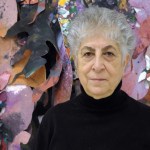
Abed Abdi
Seven decades of artistic creation.
A major retrospective spanning seven decades of Abed Abdi’s artistic career, exploring his enduring engagement with people, place, history and collective memory.
From his early years in Haifa and his studies in Dresden to his years of work in the press and his later public monuments, environmental sculptures and explorations of war and memory, the exhibition follows the evolution of an artist whose work has remained deeply connected to the social and political realities of his time.


A pioneering Palestinian visual artist.
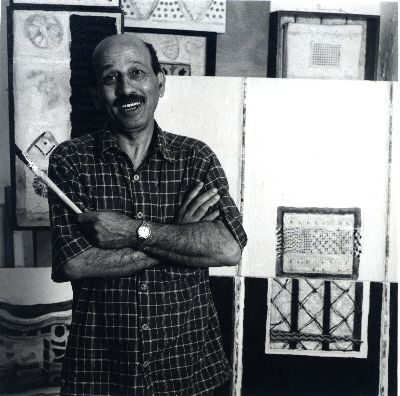
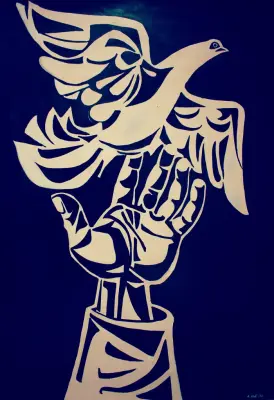
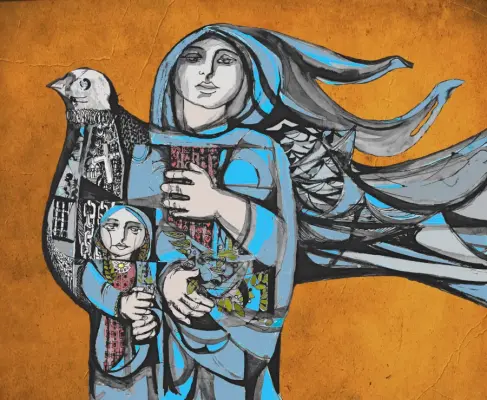
Abed Abdi has developed a distinctive visual language shaped by history, place, human experience and social reality. Throughout his career, his work has moved between intimate observation and large public narratives, combining painting, drawing, graphic art, illustration, printmaking, monuments and environmental works. As a humanist and social-realist artist, he has consistently placed people, their lives, struggles and hopes at the centre of his work.
Born in Haifa in 1942, Abdi left the city with his family in 1948 and lived as a refugee for three years. He held his first exhibition in 1961, and from 1965 to 1971 studied fine arts at the Dresden Academy of Fine Arts (HfBK Dresden), where he developed his artistic practice under the guidance of German Social Realist artists including Gerhard Bondzin and Lea Grundig, a Jewish Holocaust survivor and anti-war artist. Grundig became an important mentor and friend to Abdi, and their relationship extended far beyond the academy.
His work has been honored by his native city, Haifa, by Israeli and Palestinian cultural institutions, by the ministers of culture in Israel and Palestine, and by the President of Palestine.
Images that became collective memory.
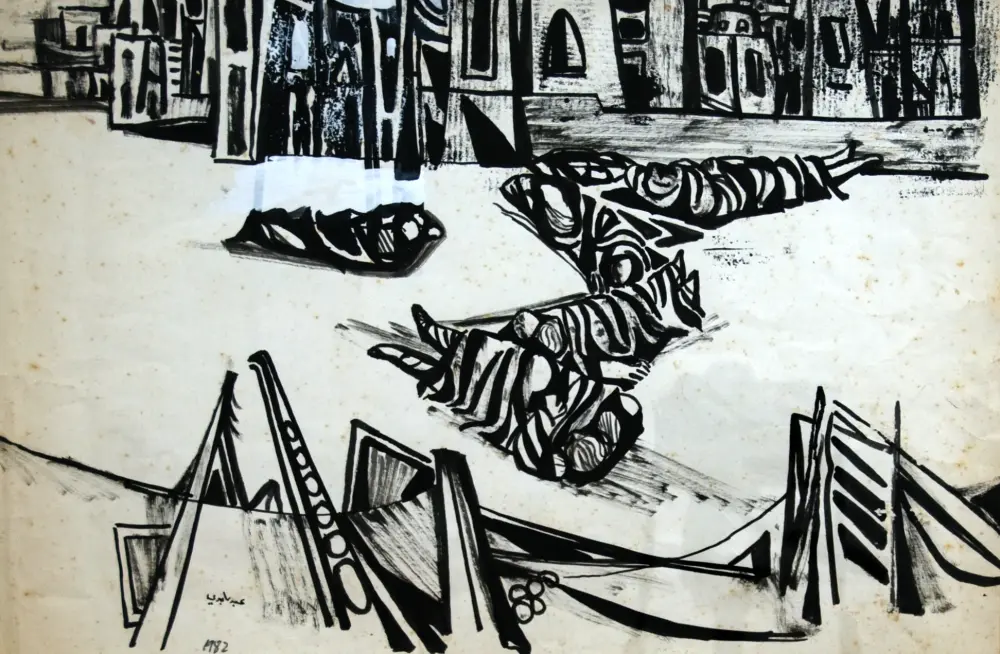
“It is these images that shaped Arab visual memory of historical events like the Nakba, the refugee camps, destroyed villages, and the events of Land Day, hence the works’ significant influence on the collective memory of the Palestinian minority..”
Jury comment, Israeli Minister of Culture’s Awards for the Arts, 2010
Explore the complete world of Abed Abdi.
Collect a piece of Palestinian art history.
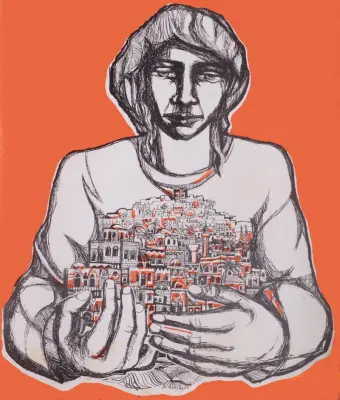
Works in Collections Worldwide


The British Museum

Barjeel Art Foundation

Millon Auctions

Sotheby's Auctions
Testimonials & Reflections
Beyond his extensive work in diverse media, Abdi’s iconography marks a long contribution to the Palestinian struggle for recognition and the voicing of Palestinian particular identity, history and suffering as a central theme of his creative work.
DR. AYELET ZOHARPROFESSOR AND CURATOR
The work you have done in the age of the internet is as monumental as Abed Abdi’s work is monumental in the history of Palestinian art !
Kamal BoullataPalestinian artist and art historian (1942-2019)He is most notably known as the first Palestinian artist living in Israel to erect monumental works in public spaces to commemorate Palestinian modern history that are still standing in Palestinian towns and villages.
Aline KhourySotheby’s, London“Awareness of the torn motherland”, is an appropriate general expression for Abdi’s creation… However, this “awareness” strives for universal justice, for universal artistic language that is beyond the borders and the issues of identity and nationality: at the center of his creation, the human figure appears time and time again, sketched in a sensitive illustration that is attentive to the suffering of human beings against the waves of history..
DR. TAL BEN ZVIPROFESSOR AND CURATORAbed Abdi is a prolific artist, having produced a significant body of work that remains largely undocumented.
SAMIA HALABYVISUAL ARTIST AND ART CRITIC