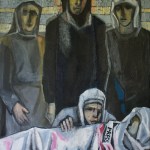
After an absence of two years—which the young painter, Abed Abdi, spent in East Germany for art studies—he returned to the country a few days ago for a two-month vacation. Abed spoke to us about his many impressions, the wide horizons that opened before him, and the deepening of his connection to his homeland while he was abroad.

We asked him: “Have you grown, Abed?”
He said: “I grew two years older; but in painting, I grew eight years. Not because of success, but because responsibility gives me this feeling.”
He continued:
“When I traveled, I had one question: Where should I take this art? Should I change my style? Should I paint colors and subjects different from the nature of my homeland? I found that my connection to my country is deeper than my attachment to houses with tiled roofs and snowy weather. It became clear to me that portraying my homeland differs in movement and style from portraying foreign places.
When a person becomes aware of the issues of his country, he cannot abandon his strong bond with it—even if he lives in a land of snow. I used to feel the warmth of my homeland in my room there, as if I were back home.”
Abed spoke about Eastern and Western art, so we asked him: “Do you see an Eastern art and a Western art?”
He said: “In essence—there is no difference. The difference lies in the environment, movement, and colors. The forms are what differ. We should not claim that Western art is far from our atmosphere, and that therefore it must be abandoned in favor of returning to ancient art.”

We asked him: “What is new in your painting now?”
He replied:
“When a person is far from his homeland, he must carry his country’s identity card with him. In my depictions of people, I emphasize that they are Arab. I learned and borrowed European subjects, but I preserved my own identity. In the past, I gave my paintings aesthetic spirit; now I see in them the story of nature and land, and I give even stones their role. I free myself from unnecessary elements.
For example: in a painting depicting a person defending the land, I emphasized the hands and eyes… and freed myself from clutter and marginal details. I now emphasize content. My studies there helped me by providing the means for development, attending lessons and lectures, and maintaining continuous daily work.”
And did you hold an exhibition there?
“A student exhibition for foreign students was held, in which 55 paintings were shown, including 23 of mine. The professors selected the works themselves. One university professor said about me:
‘Abed Abdi is trying to create his own environment. Once we entered the exhibition, we could say that these works could indeed be Middle Eastern paintings.’”
translated from Arabic. Published in Al Ittihad newspaper on 5th of August 1966